
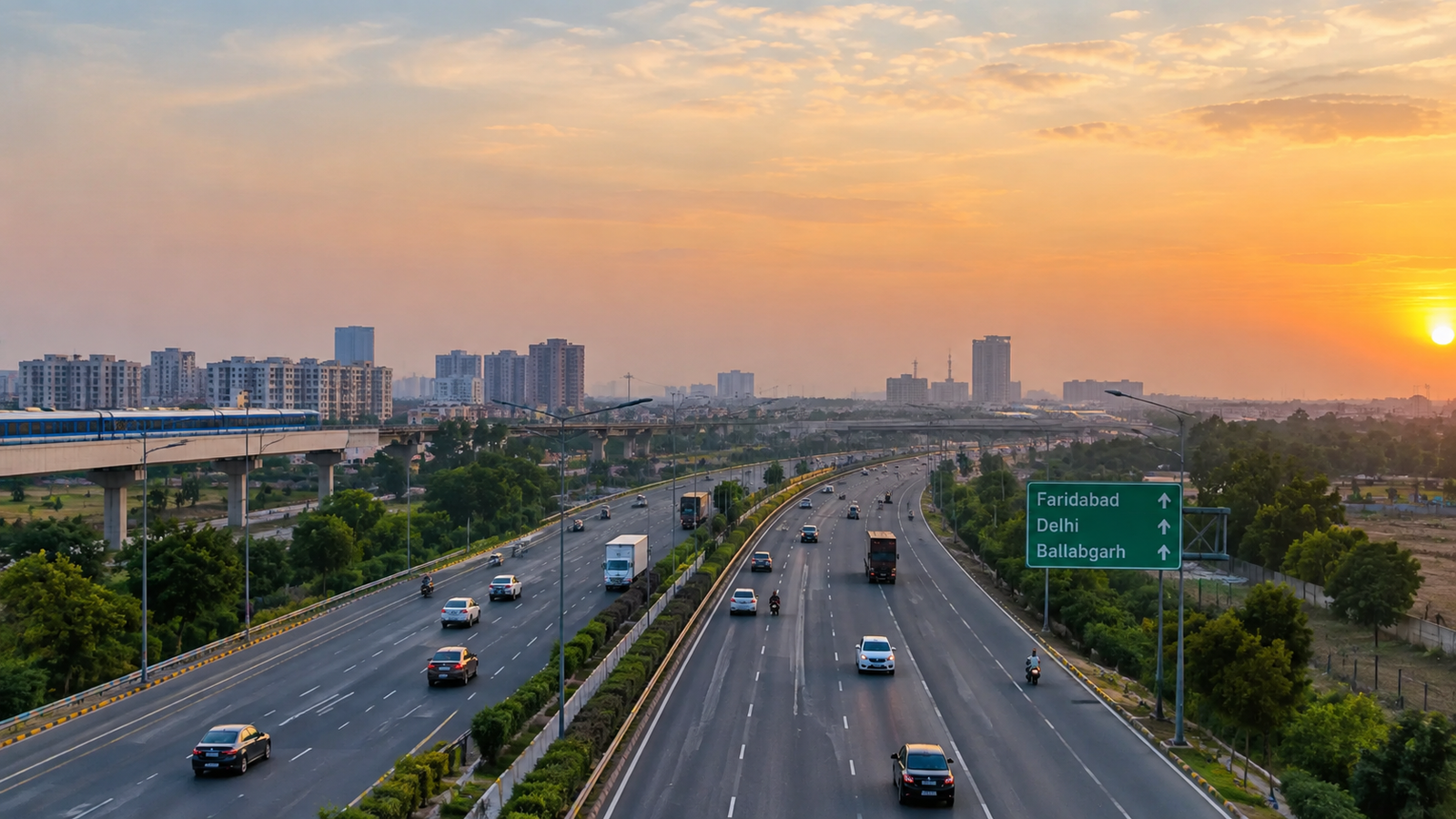
Faridabad Connectivity in 2026: What’s Changing and What It Means for Homebuyers
Ask anyone who moved to Faridabad ten or fifteen years ago why they chose it, and the answer usually comes back to South Delhi. Mathura Road ran straight there, and later the Metro did too. For a lot of families, that one link was the whole case for the city.
It still counts. But Faridabad connectivity in 2026 is starting to look rather different, because the new projects aren’t really about Delhi. They’re about getting to Gurugram, Noida, Greater Noida and the Noida International Airport at Jewar without routing everything through the capital. The Delhi–Mumbai Expressway network, the DND–Faridabad–Sohna corridor, a dedicated road to Jewar Airport and a proposed Namo Bharat line are all pulling in that direction.
The catch is that these projects are at very different stages. A few you can use today, others are still being built, and one hasn’t cleared all its approvals yet. If you’re weighing up property in Faridabad, sorting them into the right bucket is probably the most useful homework you can do.
Faridabad’s Existing Road and Metro Links
Start with what’s actually on the ground. Residents currently depend on the Delhi Metro Violet Line, NH-19 (Mathura Road), the KMP Expressway and the existing access points to the Delhi–Mumbai Expressway network.
This is your baseline. Whatever a developer tells you about upcoming corridors, the real question is whether your daily trip will be better than it would be using these routes. Sometimes the answer is yes. Sometimes a new road makes little difference to where you personally need to go.
What the 2026 Market Data Says About Faridabad Real Estate
There’s clearly been renewed interest in the city this year.
In September 2026, Financial Express reported that Faridabad made up around 10% of NCR residential sales, based on ANAROCK’s Q1 2026 figures, and that housing absorption was up 133% year-on-year. The same report cited Knight Frank’s H1 2026 data showing an 18% annual rise in residential prices. Moneycontrol has also linked some of this demand to infrastructure and regional connectivity.
Worth reading those figures for what they are, though. They tell you what happened over the past year, not what will happen over the next five. A better-connected area can attract more buyers, but an individual flat or floor still lives or dies on its exact location, the developer behind it, approvals, pricing, build quality and how much competing supply comes up nearby.
The DND–Faridabad–Sohna Corridor and Cross-NCR Road Access
Of the road projects, this is the one most likely to change how people move around the region.
The Ministry of Road Transport and Highways, in May 2026, described the DND–Faridabad–Sohna highway as a six-lane, access-controlled, high-speed corridor connecting Delhi, Faridabad, Gurugram, Noida and Sohna, with access towards the Noida International Airport and the Delhi–Mumbai Expressway.
For someone working in Gurugram or Noida, that’s a real shift. Faridabad has long been a city you reach along one main axis. A wider expressway network gives residents more than one way out, which is useful for anyone whose commute doesn’t point towards Delhi.
Check where you’d actually get on
Here’s where buyers tend to get caught out. A brochure line like “close to the expressway” says nothing about the nearest interchange. You might be a short distance from the highway as the crow flies and still have to drive a fair way through local roads to join it.
So ask the developer, specifically, which entry point residents would use, and then go and look at it. In Greater Faridabad especially, the thing to watch is whether the new links genuinely cut down reliance on the older, congested routes you’d otherwise be stuck with.
Faridabad to Jewar Airport Connectivity: The ₹3,630 Crore Corridor
On 10 March 2026, the Union Cabinet approved a revised capital cost of ₹3,630.77 crore for a 31.42-km greenfield road linking the Delhi–Faridabad–Ballabhgarh–Sohna spur of the Delhi–Mumbai Expressway with Jewar Airport.
The government’s announcement says the corridor is meant to give South Delhi, Faridabad and Gurugram direct, high-speed access to the airport. Along the way it will cross the Eastern Peripheral Expressway, the Yamuna Expressway and the Dedicated Freight Corridor.
Jewar tends to get talked about as a Noida and Greater Noida project, and understandably so. This road is a useful reminder that Faridabad falls within its reach as well. Once built, it could make the airport a good deal easier to get to from this side of NCR, which may matter to frequent flyers and to people whose work is tied to the airport region.
Namo Bharat in Faridabad: Still a Proposal
The Namo Bharat corridor is the most talked-about project and also the least certain one.
The plan is for a rapid rail line connecting Gurugram, Faridabad, Noida/Greater Noida and the Jewar Airport area. According to The Tribune in August 2026, the detailed project report for the roughly 64-km route had been approved by a committee headed by the Meerut Divisional Commissioner and sent on for further government approvals. The estimated cost was put at around ₹19,390 crore. In Faridabad, the proposed alignment runs near Sector 87/88 and Bata Chowk before heading towards Gurugram.
To be clear: this corridor is proposed. It isn’t operational, and as of August 2026 it was still going through government approvals.
You’ll probably see it mentioned in project advertisements anyway, often in the same list as roads that already exist. That’s the moment to slow down. A rail line awaiting sanction shouldn’t carry the same weight in your decision as a Metro line you can ride today, however promising it looks.
Greater Faridabad Connectivity Varies by Sector
Greater Faridabad has grown into one of the city’s biggest residential pockets, with large group housing projects, plotted colonies and social infrastructure that’s still filling in.
For years, people judged it mainly on how quickly they could get to central Faridabad or Delhi. Its eastern position now means it’s also being viewed in relation to Noida, Greater Noida, Gurugram, the Delhi–Mumbai Expressway and the Jewar corridor, which has made Greater Faridabad real estate part of a broader regional conversation.
That said, it’s a large area. How much any of these corridors helps will depend on which sector you’re in, what the local roads are like and how far you are from an interchange that’s actually open. Two projects a few kilometres apart can have very different commutes. Compare real driving routes, ideally at the hour you’d be travelling.
Faridabad Infrastructure by Status: A Quick Reference
| Status | Infrastructure |
|---|---|
| Existing | Delhi Metro Violet Line; NH-19 / Mathura Road; KMP Expressway; existing access to the Delhi–Mumbai Expressway network |
| Under development / expanding | DND–Faridabad–Sohna connectivity; Jewar Airport greenfield road corridor |
| Proposed / awaiting further approvals | Namo Bharat corridor linking Gurugram, Faridabad, Noida/Greater Noida and the Jewar region |
When a project page lists “nearby infrastructure,” it’s worth mentally slotting each item into one of these rows.
Checking a Property’s Connectivity Yourself
Most listings describe their location as excellent. That tells you nothing on its own.
A more reliable approach is to do a bit of legwork. Map the route from the property to the nearest main road and find out whether the closest interchange is open or still under construction. Drive it on a weekday morning, or whenever you’d normally be leaving for work, because a route that’s easy at noon on a Sunday can be a different story at 9 am. Check how far the nearest Metro station really is and how you’d get there. For any announced project, look up its status on official government sources rather than taking the developer’s word for it.
And ask yourself honestly whether the corridor being advertised has anything to do with your own commute. A road to Jewar is excellent news for some households and largely irrelevant to others.
One more thing to keep in mind: distance can mislead. A home 2 km from an expressway can end up with worse practical access than one 5 km away, simply because of where the entry points are or how clogged the local roads get.
Does Better Connectivity Mean Higher Property Prices in Faridabad?
It can help, but there’s no automatic link. Better roads and transit can make an area easier to reach and more appealing to residents and businesses, and Faridabad’s recent market figures have come alongside real infrastructure progress. Still, strong growth in one year says nothing definite about the next.
Treat connectivity as one input among many. RERA registration and approvals matter. So does the developer’s track record, whether the project is ready or still under construction, the gap between the quoted price and what you’ll actually pay, maintenance charges, nearby schools and hospitals, rental and end-user demand, and how much new supply is planned in the same micro-market. Put together, those tell you far more than any single highway announcement.
Faridabad Connectivity 2026: Where Things Stand
Faridabad is slowly becoming part of a wider NCR network, rather than just a residential extension of Delhi. The expressway links, the Jewar road corridor and, if it goes ahead, the Namo Bharat line could strengthen its ties with Delhi, Gurugram, Noida and Greater Noida over the coming years.
For buyers, that’s genuinely encouraging, but it also means more to verify. Know what exists now, what’s being built and what’s still on paper, and then look at how each one affects the particular sector and home you have in mind.
If you’re comparing options in the city, you can browse BPTP projects in Faridabad, including BPTP Floors in Faridabad, or request details on available properties.